
Booked & Printed
by Laurel Flores Fantouzzo
Perhaps a home always holds secrets. Visitors might leave unexpected gifts, or unwelcome items from the outside world. Older, long-time residents of a home might bury devalued detritus, leaving evidence in hidden corners for descendants to find, and wonder about, years later. And in a family home, a member of the family might carry sinister intentions, ones that others might discover too late. This issue, Booked and Printed enters the homes of characters coping with mysteries in their midst, discovering the true nature of the inhabitants around them.
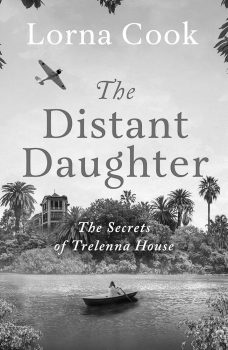 In the historical romance and mystery The Distant Daughter, author Lorna Cook introduces two characters in two very different eras. Lamorna is in present-day Cornwall, having fled her life in Singapore to return home to the United Kingdom. Another character, Issey, is enjoying her life in 1940s Singapore, before the Japanese military launches a decimating attack on the island. Her idyllic day-to-day life turns into a wartime rush for sanctuary. She is guided through danger by Alex Cartwright, a staid, dour man who grows more interesting to her by the minute.
In the present-day, while renovating their vast family estate, Trelenna House, Lamorna finds Issey’s worn but readable journal. With the help of Zach, an intriguing local archivist, Lamorna launches an investigation into what happened to Issey and Cartwright, and whether Issey might be related to the family at all. The sections in present-day Cornwall read like a languid, cozy romance; the historical sections in the 1940s have the clip and feel of a thriller.
One omission of the book is any meaningful engagement with present-day Singapore. We know Lamorna has fled the city-state after a terrible relationship, and there is mention of Singapore’s rooftop bars. But there are few details of modern Singapore beyond that—nothing of the malls with proprietary perfumed air, for example, or the plaques quietly mentioning the devastations of World War II in everyday locales, or the famously opulent, efficient Changi airport. The Singapore of the 1940s, albeit thoroughly from the colonialists’ point of view, receives much more well-developed, sensory attention. That attention, along with Issey and Alex’s rush to safety, make the 1940s sections the most heart-pounding and vivid of the book.
The Distant Daughter is the first in a continuing series about the secrets of Trelenna House, and it is a promising beginning for more discoveries in the estate’s archives.
 In the nonfiction memoir Unfollow Me, Kathryn Caraway tells her story under a pseudonym for reasons that soon become terrifyingly clear. Reeling from the collapse of multiple relationships, Kathryn meets Todd, an amiable man who runs IT systems for local law enforcement. He seems kind and interested in Kathryn, and he begins regular visits to her home. He offers to rent office space from her to offset the housing costs that drain her savings, along with an expensive divorce lawyer working on her behalf. Kathryn accepts him into her home, with his sophisticated IT setup. Kathryn and Todd date, but soon after, feeling less than amorous, Kathryn ends the relationship.
Throughout her interactions with Todd, Kathryn grows troubled by his controlling behavior: offhand phrases that cast blame on her, his unexpected presence in places she visits around town, his insistence on spending time with her despite what else she might have planned. She tells herself a story: she is merely wounded from past relationships, and she might be rejecting a good suitor and friend.
But Todd’s behavior grows so merciless as to be absurd. He installs cameras that in Kathryn’s home that she and other IT professionals cannot access. He installs cameras in restaurants she visits, and shows up each time she is there. He follows her in his truck around town. The strength of the book is in showing, with tortured clarity, the absurdity of the legal system betraying stalking victims. When Todd eventually is assigned an ankle monitor, no one can tell her whether or not it the monitor has been turned on. She must travel through several phone trees of lawyers, police, and the private company administering the ankle monitors itself. Her testimony shows that the institutions that should protect stalking victims often betrays them with neglect instead.
Throughout Unfollow Me, some metaphors are repetitive: the mention of being on a rollercoaster, or of poking the bear, and so on. The repeated phrases seem to disclose a rush by the narrator to get as much of the story out as quickly as possible, as if she were still being chased by a sadistic cretin. Readers might grow frustrated at Kathryn for re-starting a friendship with Todd after he assaults her. But to blame Kathryn is to participate in the myth that a victim is to blame for her own victimization. The book reminds us that the targets of stalking and domestic violence are not always confused and unhealthily attached to their perpetrators. In ameliorating the abuser, they are deploying survival skills, doing everything they can to protect themselves when the legal system and the greater community will not.
 Perfect Happiness, by thriller writer You-Jeong Jeong, has undergone a new translation by Sean Lin Halbert. The novel depicts the effects of a woman who is the absolute opposite of nurturing. In present-day South Korea, Yuna Shin is a confusing wife and mother. She can veer from cruel to affectionate from moment to moment. Her intermittent, unpredictable warmth masks the chilling decisions she makes.
With changing third-person points of view, each member of the family comes to the gradual realization that Yuna may be orchestrating the most shocking of crimes, all in the pursuit of her own, narcissistic idea of happiness. Yuna seems determined to wound the family as much as possible under the roof of their own home, to her own horrifically selfish ends.
Jeong’s frank and adept portrayal of Yuna’s acts, from the perspectives of the individuals surrounding her, remind us that the most sadistic behavior is often perpetrated in the domestic sphere: crimes hidden and devastating.
All Points Bulletin: Fire Must Burn, the eighth book in Allison Montclair’s Sparks & Bainbridge series, is now out from Severn House. Allison Montclair is a pseudonym of AHMM author Alan Gordon. • Last year’s blockbuster, The God of the Woods (Riverhead Books) by Liz Moore was awarded the 2024 Dashiell Hammett Award for Literary Excellence in Crime Writing from the International Association of Crime Writers (North American Branch). Shortlisted for this award were Broiler (Soho) by Eli Cranor; Rough Trade (MacMillan) by Katrina Carrasco; Crooked (ECW Press) by Dietrich Kalteis; and The Long-Shot Trial (ECW Press) by William Deverell. • MWA Grand Master Bill Pronzini has a new collection of stories from Stark House: Tales of the Impossible. • R. J. Koreto first introduced Captain Edmund Winter in these pages with “Winter’s Journey” (January/February 2017). He is now featured in a new series: Winter’s Season: A Regency Mystery, which came out in January from Histria Books.